

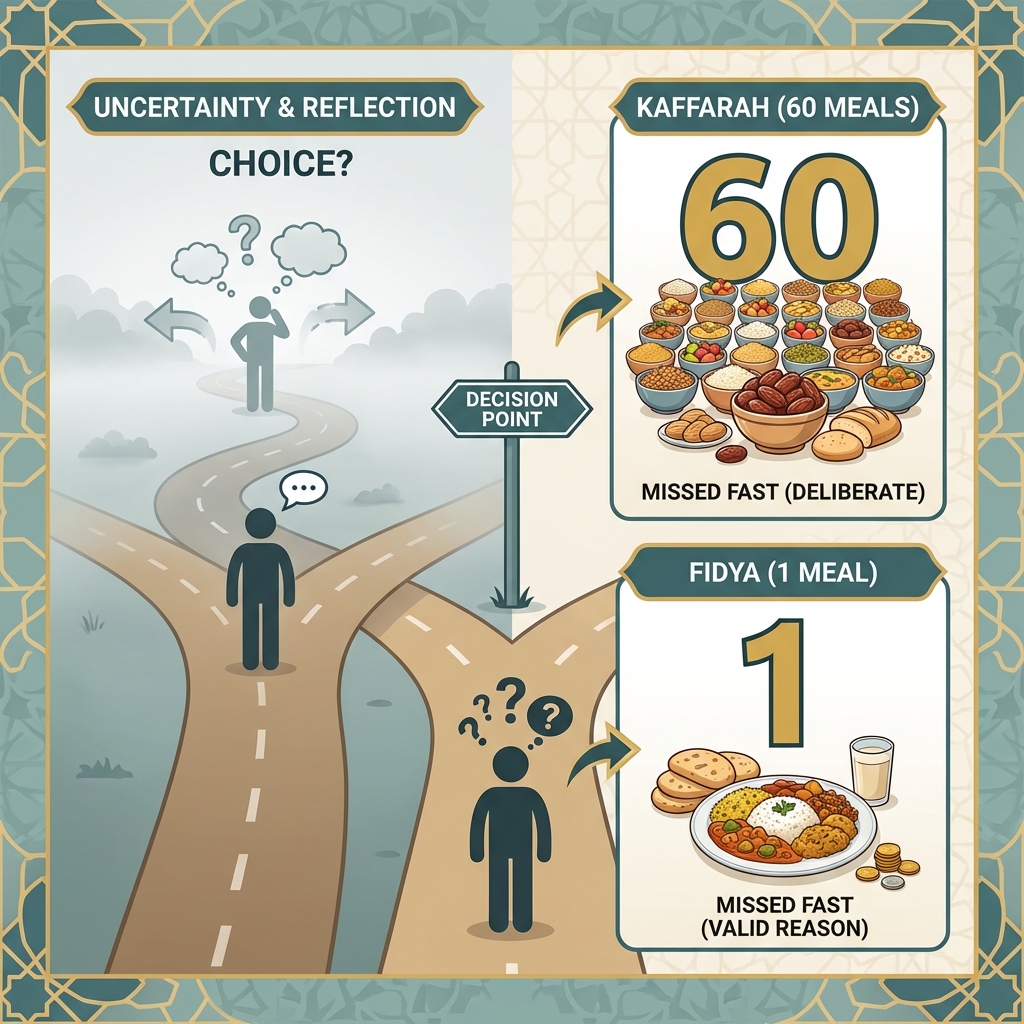
Understanding the difference between kaffarah and fidya could save you from making the wrong payment—and ensure your religious obligation is properly fulfilled.
Every Ramadan, thousands of Muslims find themselves in situations where they can’t fast or accidentally break their fast. When this happens, two Islamic concepts come into play: kaffarah and fidya. While both involve feeding the hungry, they serve different purposes and have vastly different requirements.
The confusion between these two obligations is understandable—both relate to missed or broken fasts, both involve charitable giving, and both help address food insecurity. However, making the wrong payment could mean your religious obligation remains unfulfilled.
Understanding Kaffarah: The Greater Expiation
Kaffarah is required when someone intentionally breaks their Ramadan fast without a valid excuse. This isn’t about accidentally drinking water or eating out of forgetfulness—kaffarah applies to deliberate violations of the fast.
The kaffarah requirement is significant: freeing a slave (not applicable today), fasting for 60 consecutive days, or feeding 60 needy people. Most Muslims today fulfill kaffarah through the feeding option, which translates to approximately $900 at current rates ($15 per person × 60 people).
The severity of kaffarah reflects the seriousness of intentionally breaking a Ramadan fast. Islamic law treats this as more than just a missed day of worship—it’s viewed as a violation of one of Islam’s fundamental pillars during its most sacred month.
Understanding Fidya: The Substitute Payment
Fidya, on the other hand, is required when someone cannot fast due to circumstances beyond their control. This includes:
- Chronic illness that makes fasting dangerous
- Pregnancy or breastfeeding concerns
- Advanced age where fasting poses health risks
- Essential travel that cannot be delayed
- Mental health conditions that contraindicate fasting
Fidya is calculated as one meal for one needy person per missed day of fasting. At current rates, this equals approximately $15 per missed fast. Someone who cannot fast for the entire month of Ramadan would owe $450 in fidya payments.
The Key Differences Explained
The fundamental difference lies in intention and circumstance:
Kaffarah applies when you:
- Intentionally break your fast without a valid excuse
- Engage in marital relations during fasting hours
- Deliberately violate the fast through eating or drinking
Fidya applies when you:
- Cannot fast due to medical conditions
- Are pregnant or breastfeeding and fasting poses risks
- Are elderly and fasting threatens your health
- Must travel for essential reasons during Ramadan
The payment amounts also differ dramatically. Kaffarah requires feeding 60 people ($900), while fidya requires feeding one person per missed day (typically $15 per day).
Common Scenarios and Their Solutions
Scenario 1: Diabetes Management
Sarah has Type 1 diabetes and her doctor advises against fasting during Ramadan. She cannot safely fast without risking dangerous blood sugar fluctuations.
Solution: Fidya – $15 per missed day
Scenario 2: Intentional Breaking
Ahmed deliberately breaks his fast on the 10th day of Ramadan because he’s at a work lunch and doesn’t want to explain his fasting to colleagues.
Solution: Kaffarah – $900 for feeding 60 people
Scenario 3: Pregnancy Concerns
Fatima is seven months pregnant and her doctor recommends avoiding fasting to ensure proper nutrition for her baby.
Solution: Fidya – $15 per missed day
Scenario 4: Accidental Eating
Omar forgets he’s fasting and drinks coffee in the morning, then remembers and immediately stops.
Solution: Neither kaffarah nor fidya required – continue the fast
The Spiritual Significance Behind the Payments
Both kaffarah and fidya serve purposes beyond individual obligation fulfillment. They create a direct connection between personal religious circumstances and community welfare.
When someone pays kaffarah for intentionally breaking their fast, they’re acknowledging the seriousness of their action while simultaneously providing substantial support to those experiencing food insecurity. The requirement to feed 60 people ensures that one person’s religious violation becomes a significant community benefit.
Fidya operates on similar principles but recognizes that circumstances beyond our control shouldn’t prevent us from contributing to community welfare. When illness or other valid reasons prevent fasting, fidya ensures that the individual remains connected to the spiritual and charitable aspects of Ramadan.
Calculating Your Obligation Correctly
For kaffarah calculation:
- One intentional fast-breaking incident = feeding 60 people
- Current rate: $15 × 60 = $900
- This applies per incident, not per day
For fidya calculation:
- Count the total number of missed fasting days
- Multiply by $15 (current rate for feeding one person)
- Example: 15 missed days = 15 × $15 = $225
Making Payments That Count
Whether you owe kaffarah or fidya, ensuring your payment reaches those who need it most maximizes both your religious fulfillment and community impact. Look for organizations that:
- Specialize in Islamic charitable giving
- Have transparent fund distribution practices
- Serve communities with high food insecurity rates
- Provide culturally appropriate food options
- Maintain clear documentation for religious compliance
Beyond Individual Obligation
Understanding kaffarah vs fidya reveals Islam’s nuanced approach to religious obligation and community responsibility. The system recognizes that circumstances vary, intentions matter, and religious practice should contribute to broader social welfare.
For American Muslims, these payments represent an opportunity to address food insecurity in their own communities while fulfilling religious obligations. When thousands of Muslims collectively pay fidya and kaffarah, they create a substantial funding stream for hunger relief that operates independently of government programs or secular charitable giving.
Common Mistakes to Avoid
- Paying fidya for intentional fast-breaking: If you deliberately broke your fast, fidya isn’t sufficient—you need kaffarah.
- Paying kaffarah for unavoidable circumstances: If illness prevented your fasting, kaffarah’s 60-person requirement is unnecessarily burdensome—fidya is appropriate.
- Incorrect calculations: Remember that kaffarah is per incident of intentional breaking, while fidya is per missed day.
- Delayed payments: While there’s flexibility in timing, prompt payment ensures hungry families receive support when they need it most.
Getting Expert Guidance
If you’re unsure whether your situation requires kaffarah or fidya, consult with a knowledgeable Islamic scholar or imam. The distinction matters not only for proper religious compliance but also for ensuring your charitable contribution matches the appropriate level for your circumstances.
The difference between paying $15 and $900 is significant, and making the wrong choice could mean either overpaying unnecessarily or failing to fulfill your religious obligation completely.
Ready to make your kaffarah or fidya payment with confidence? Learn more about ensuring your Islamic obligations create maximum community impact: